Debt-Free Journey Tips for Millennials
Written by DebtExit Editorial
Reviewed against our editorial standards
Understanding Your Current Debt Landscape: Assessment & Audit
Before you can crush your debt, you need to know exactly what you're fighting. Most people underestimate their total debt because they're only thinking about credit cards and student loans, forgetting about that personal loan from 2019 or the $800 still owed to Mom.
Start with a complete debt inventory. Open a spreadsheet and list every single debt: credit cards, student loans, car loans, personal loans, medical debt, money owed to family, and even that Buy Now Pay Later balance from your last online shopping spree. For each debt, record the creditor name, total balance, minimum payment, interest rate, and due date.
Here's where it gets real. Calculate your total debt-to-income ratio by dividing your total monthly debt payments by your gross monthly income. If you're above 36%, you're in the range where lenders start treating you as high-risk. Above 40%, you're likely feeling the squeeze every month.
Next, identify your highest and lowest interest rates. That credit card charging 24.99% is costing you roughly $25 a year for every $100 you carry. Meanwhile, a federal student loan at 3.5% costs about $3.50 per $100. This math will guide your payoff strategy later.
Don't forget the emotional audit. Rank each debt by stress level from 1 to 10. The result is often surprising: the highest-stress debt is frequently not the largest one. Money owed to a family member, or a debt tied to a relationship you see regularly, tends to outrank a much bigger balance sitting anonymously with a bank. That ranking matters, because a debt that costs you sleep has a real price even when the interest rate is zero.
Track payment dates and amounts religiously. Late fees are wealth killers, especially when you're already stretched thin. A single $35 late fee on a $2,000 credit card balance is the equivalent of adding roughly 21 percentage points of annual interest for that month.
Finally, calculate your debt-free date using online calculators for each debt if you only make minimum payments. Seeing how many years a modest credit card balance takes to clear on minimums alone is the wake-up call most people need.
Take photos of all statements and save them in a "Debt Freedom" folder on your phone. This creates accountability and makes the numbers impossible to ignore. You can't manage what you don't measure, and you can't crush what you won't face.
This audit might feel overwhelming, but knowledge is power. You're not just organizing numbers. You're taking the first step toward financial freedom. Every wealthy person started somewhere: acknowledging the reality and deciding to change it.
Crafting a Powerful Debt-Free Mindset and Realistic Goals
Your relationship with debt starts in your head, and shifting your mindset is the difference between giving up after three months and actually crossing the finish line. For most people the hardest part of a large balance isn't the math. It's the belief that the number is beatable at all.
Stop thinking of debt payoff as punishment and start viewing it as buying back your freedom. Every extra payment isn't money you're "losing." It's literally purchasing months or years of your future life back from creditors. That $200 extra payment on your student loan? You just bought yourself three months of freedom.
Here's how to set goals that actually stick: use the 90-day sprint method instead of focusing on your total payoff timeline. If you owe $25,000 and your payoff date is three years away, that feels impossible. But saying "I'll pay an extra $500 in the next 90 days" feels totally doable.
Write down your specific "why" and make it emotional. "I want to be debt-free" is weak. "I want to take a two-week vacation without using credit cards" or "I want to move out of my parents' house without financial stress" hits different. Your why needs to make you uncomfortable when you think about NOT achieving it.
Create micro-celebrations for small wins. Paid off a credit card? Do a happy dance and post about it. Hit your 90-day goal? Treat yourself to a $20 dinner (not a $200 shopping spree). These moments of recognition keep your motivation alive during the inevitable rough patches.
Track your net worth monthly, not just your debt balances. Use a free tracking app and watch that negative number climb toward zero. Seeing your net worth move from -$23,000 to -$21,500 in one month creates momentum that "I still owe $21,500" simply doesn't provide.
The biggest mindset shift? Understanding that being debt-free isn't about living like a monk forever. It's about having choices. When you don't owe anyone money, you can take career risks, travel spontaneously, or handle emergencies without panic.
Set a realistic timeline by calculating your actual capacity. Take your monthly surplus (income minus essential expenses) and multiply by 0.8. That's your sustainable debt payment amount. Don't plan to throw every spare dollar at debt, because you'll burn out. Leave room for life, or you'll quit when the first unexpected expense hits.
Your debt-free journey isn't a sprint. It's a strategic game where consistency beats perfection every single time. For strategies built specifically around the financial pressures millennials face in 2026, see our millennial-focused debt payoff strategies guide. If you want a concrete sense of how long this will actually take, check our debt payoff timeline guide for realistic benchmarks by debt amount.
Mastering Your Budget: The Foundation for Faster Debt Payoff
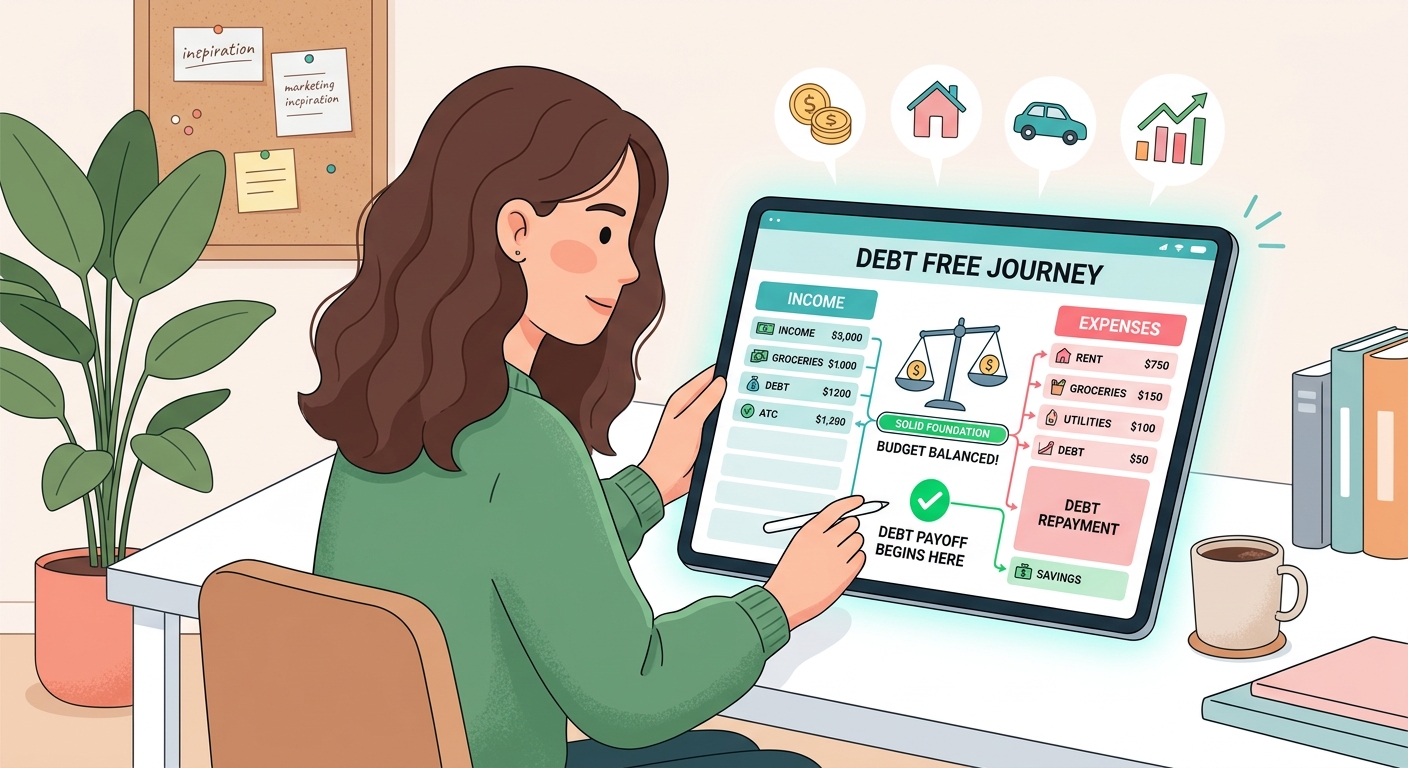 Let's be real: budgeting isn't sexy, but it's your secret weapon for crushing debt faster than you thought possible. Most people who finally build a real budget describe the same reaction, which is surprise at where the money was actually going. You can't redirect spending you can't see.
Start with the 50/30/20 rule, then flip it. Normally, you'd allocate 50% to needs, 30% to wants, and 20% to savings and debt. But when you're in debt-crushing mode, reverse that 30% and 20%: put 30% toward debt payoff and limit wants to 20%. This single shift can accelerate your timeline by years.
Track every dollar for one full month before making any changes. Use a budgeting app or even a simple spreadsheet. Subscriptions, takeout, and small impulse purchases are the categories that most often turn out to be larger than expected.
Here's your debt-crushing budget framework: list all income sources, then subtract fixed expenses (rent, utilities, minimum debt payments). Whatever's left gets divided into three buckets: survival money (groceries, gas), debt payoff fund, and a small fun fund (yes, you need this to stay sane).
The envelope method works wonders for variable expenses. Allocate specific amounts for groceries ($300), entertainment ($50), and miscellaneous ($100). When it's gone, it's gone. No borrowing from other categories.
Build mini-emergency buffers, not full emergency funds. While conventional wisdom says save 3 to 6 months of expenses, when you're paying 18% credit card interest, start with just $500 to $1,000 as a starter emergency fund. Every dollar beyond that should attack your highest-interest debt.
Automate your debt payments the day after payday. Set up automatic transfers so your debt payment happens before you can spend that money elsewhere. Treat that transfer like rent: a non-negotiable bill, not a leftover. If you haven't mapped out exactly which debts to hit and in what order, you can build a complete payoff plan in 30 minutes using a process that covers the budget piece too.
Review and adjust monthly. Your first budget won't be perfect, and that's okay. Track what worked, what didn't, and where you overspent. Maybe you allocated too little for groceries but too much for entertainment.
The magic happens when budgeting becomes a habit, not a chore. After three months of consistent tracking, you'll naturally start making smarter spending decisions without even thinking about it. You'll skip that $12 lunch because you know it's $12 closer to freedom.
Remember: every dollar you don't spend is a dollar that can eliminate debt faster. Your future self will thank you for every sacrifice you make today.
Choosing and Implementing Your Debt Payoff Strategy (Snowball vs. Avalanche)
Now comes the million-dollar question: snowball or avalanche method? Both strategies work, but the right choice depends on your personality and financial situation.
The debt snowball method focuses on paying minimums on all debts while throwing every extra dollar at your smallest balance first. Once that's gone, you roll that payment into the next smallest debt. It's psychologically powerful because you see quick wins.
The debt avalanche method targets your highest interest rate debt first while paying minimums on everything else. Mathematically, this saves you more money over time, but it requires stronger willpower since progress feels slower initially.
Here's an illustrative example. Imagine a borrower with three debts: a $2,000 credit card at 24% APR, an $8,000 car loan at 6% APR, and a $15,000 student loan at 4% APR. With snowball, they'd tackle the $2,000 card first. With avalanche, they'd attack that same 24% card first, because in this case the smallest balance is also the most expensive. When those two happen to line up, the choice doesn't matter. Often they don't line up, and that's when the decision has real consequences.
Choose snowball if you: need motivation through quick wins, have struggled with debt payoff before, or have similar interest rates across debts. The value of watching an entire account disappear is real, and it's the reason snowball has strong completion rates even though it costs slightly more in interest. Not sure which method fits your situation? The full snowball vs. avalanche comparison breaks it down with real numbers.
Choose avalanche if you: are disciplined about long-term goals, have significantly different interest rates (like 6% vs 22%), or want to minimize total interest paid. The math is clear: you'll save hundreds or thousands in interest.
Implementation is everything. Pick your strategy and automate it immediately. Set up automatic payments for minimums on all debts, then schedule your extra payment to hit the target debt right after payday. This removes the temptation to spend that money elsewhere.
Track your progress visually. Create a simple spreadsheet or use a debt payoff app. Update it monthly and celebrate each milestone. When you see that balance dropping consistently, it reinforces your commitment.
Don't switch strategies mid-journey unless your financial situation dramatically changes. Debt payoff is a marathon, not a sprint. Consistency beats perfection every time.
The best debt payoff strategy is the one you'll actually stick with. Both methods work. What matters most is starting today and maintaining momentum until you're completely debt-free.
Boosting Your Income and Strategically Cutting Expenses to Accelerate Progress
Getting out of debt faster requires attacking it from both sides: earning more and spending less strategically. The two compound. Adding $200 a month in income while cutting $150 in expenses creates a $350 monthly attack on your balance, which on a mid-five-figure debt can pull months off the timeline.
Start with the income side because it has unlimited potential. The gig economy is your best friend here. Rideshare driving during peak hours can net $15 to $25 an hour, while food delivery apps offer flexible scheduling around your day job.
Freelance your existing skills for higher returns. If you're decent with social media, small businesses will pay $300 to $800 monthly for basic management. Good with Excel? Bookkeeping services start around $25 an hour. Even basic graphic design using Canva can earn $15 to $30 per project.
Sell everything that's not nailed down. That guitar collecting dust? List it. Designer clothes you never wear? Consignment shops or Poshmark. Old electronics, textbooks, and furniture are the categories that typically clear fastest, and a focused three-month purge of unused items is one of the few ways to generate a meaningful lump sum without adding hours to your week.
Now for strategic expense cutting, with emphasis on strategic. Don't just slash everything and make yourself miserable. Start with the big three: housing, transportation, and food.
Housing hacks include getting a roommate (often $400 to $800 in monthly savings), negotiating rent renewal, or house-sitting for traveling neighbors. Transportation wins mean refinancing your car loan, using public transit twice weekly, or carpooling to save $100 to $200 monthly on gas and parking.
Food expenses offer quick wins without feeling deprived. Meal prep can cut a takeout-heavy food budget substantially. Buy generic brands for staples and save $30 to $50 monthly without noticing taste differences. Limit restaurant meals to once weekly instead of three times.
Audit your subscriptions ruthlessly. Most people carry $50 to $80 in monthly subscriptions they barely use. Cancel everything for 30 days, then only reactivate what you genuinely missed.
Negotiate everything. Call your phone, internet, and insurance providers annually. Say you're comparing rates and ask for their best offer. This 20-minute call typically saves $20 to $40 monthly per service.
The magic happens when you redirect every saved dollar and earned extra dollar straight to debt. Don't let lifestyle inflation steal your momentum. That extra $350 monthly becomes $4,200 annually, enough to eliminate a credit card or make serious progress on student loans.
Track your progress weekly. Seeing those balances drop faster creates momentum that motivates even bigger moves. Small actions compound into debt freedom faster than you think possible.
Staying Motivated, Celebrating Wins, and Avoiding New Debt Traps
Let's be real: staying motivated during your debt payoff journey is harder than starting it. The initial excitement fades around month 3, and suddenly that $200 minimum payment feels like climbing Mount Everest every month.
Here's what keeps people going through that stretch: celebrate every single win, no matter how small. Paid off a $500 credit card? That's worth a $10 coffee celebration, not a $100 dinner out. Made an extra $50 payment? Screenshot that balance and share it with your accountability partner.
Create visual progress markers that make your wins tangible. Use a debt thermometer printout, color in a chart, or update a phone app daily. When you can see that balance dropping from $15,247 to $14,847, it hits different than just knowing you made a payment.
Set milestone rewards at 25%, 50%, and 75% debt elimination. Maybe it's a massage at 25% or a weekend camping trip at 50%. Keep rewards under $100 and never finance them. Cash only.
Now, about those debt traps waiting to sabotage your progress. The biggest trap? Lifestyle inflation when you start seeing extra money. That $300 car payment you eliminated doesn't become your new shopping budget. It goes straight to the next debt.
Unsubscribe from every retailer email sending you "deals." Delete shopping apps from your phone. This one is worth taking literally: if you have to re-download an app to buy something, you'll think twice about that impulse purchase.
The "I deserve this" trap is equally dangerous. You've been working hard, making sacrifices, so surely you deserve that $800 weekend getaway? Wrong. You deserve financial freedom more than temporary pleasures.
Create friction for spending by removing saved payment methods from websites, using cash for discretionary spending, and implementing a 48-hour rule for any purchase over $50. If you still want it after two days, and it fits your budget, then consider it.
Find free or cheap alternatives for entertainment and stress relief. Hiking instead of shopping, potluck dinners instead of restaurants, library books instead of bookstore browsing. Your debt-free future self will thank you.
Track your "why" daily, whether it's buying a house, traveling debt-free, or just sleeping better at night. When motivation dips, that clear vision pulls you through the tough months.
Remember: every dollar you don't spend on unnecessary stuff is a dollar attacking your debt. Stay focused, celebrate the small wins, and guard your progress fiercely. And if motivation starts slipping around month four or five, that's totally normal. Read our guide on debt fatigue and how to keep going before you quit.
Beyond Debt: Building Wealth and Achieving Financial Independence
Congratulations! You've crushed your debt and now it's time for the real wealth-building magic to begin. This is where your financial journey transforms from defense to offense.
Start with your emergency fund immediately. Aim for 3 to 6 months of expenses in a high-yield savings account. If you're spending $3,000 monthly, that's $9,000 to $18,000 sitting safely for life's curveballs.
Next, maximize your 401(k) match, which is literally free money. If your employer matches 3%, contribute at least 3% to grab that instant 100% return. Then work toward contributing 15% to 20% of your income between 401(k) and IRA contributions.
Open a Roth IRA and automate monthly contributions up to the annual limit (check the current-year IRS limit before you set the amount, since it adjusts for inflation). Contributing consistently in your 20s or 30s gives compound growth decades to work, and that time in the market matters far more than the exact amount you start with.
Consider low-cost index funds like broad total-market funds with expense ratios under 0.1%. Set up automatic investments so you're buying consistently, regardless of market ups and downs.
House hacking can accelerate wealth building significantly. Buy a duplex, live in one unit, rent the other. The rental income helps cover your mortgage while you build equity, and in the right market it can cut your effective housing cost dramatically.
Track your net worth monthly with a free tracking app. Watching those numbers climb becomes addictive, the same way tracking debt payoff motivated you before. Celebrate every $10,000 milestone.
Consider side hustles with scalable income potential. Freelancing, online courses, or rental properties can generate passive income streams. The goal isn't working more forever. It's building assets that eventually work for you.
Remember when paying off debt felt impossible? Almost everyone who finishes describes that same feeling at the starting line. Now apply that same focused intensity to wealth building. The habits you developed (budgeting, tracking, staying consistent) are your secret weapons for building serious wealth.
Set a target retirement number and work backward. Break big goals into monthly actions, just like you did with debt elimination.
The best part? Every dollar you invest now works harder than dollars invested later. You're not just building wealth. You're buying your future freedom.
Get Strategies That Actually Work
Research-backed debt payoff strategies, delivered weekly. Free, no spam.
About the Author
DebtExit Editorial
Research-backed debt payoff strategies
DebtExit publishes research-backed debt payoff strategies and free planning tools. Articles are sourced from the Consumer Financial Protection Bureau, the Federal Reserve, Experian, and peer-reviewed research, then reviewed against our published editorial standards. DebtExit provides educational content, not personalized financial advice.