Best Debt Payoff Tracking Apps, Ranked
Written by DebtExit Editorial
Reviewed against our editorial standards
Why Debt Tracking Apps Are Essential for Millennials
 Let's be honest: managing debt the old-fashioned way isn't working for most millennials. Spreadsheets get forgotten, paper statements pile up, and that "I'll check my balances later" mentality keeps you trapped in the debt cycle longer than necessary.
Debt tracking apps solve the visibility problem. For most people the breakthrough in a payoff plan is not finding extra money, it's finally seeing exactly where every dollar is going and how each payment moves the needle. You cannot manage a number you never look at.
Your phone is already your financial command center. You check your bank balance, pay bills, and transfer money from apps. Adding debt tracking to this ecosystem creates a seamless workflow that actually sticks. No more hunting for login credentials or wondering which credit card had that $2,847 balance.
Visual progress tracking triggers psychological wins that keep you motivated during the long payoff journey. Apps transform abstract numbers into progress bars, countdown timers, and milestone celebrations. Seeing your total debt drop from $23,456 to $22,891 after one payment creates momentum that spreadsheets simply can't match.
Automation eliminates the "oops, I forgot" excuse that derails debt payoff plans. The best apps send payment reminders, track due dates, and even calculate optimal payment amounts using proven strategies like debt avalanche or snowball methods. This removes guesswork and decision fatigue from your monthly routine, which is especially important if you're managing debt with ADHD, where executive function challenges make manual tracking unsustainable.
Real-time updates prevent costly mistakes. When your app syncs with your accounts, you'll catch issues like missed payments, interest rate changes, or promotional rate expirations before they cost you hundreds in fees or higher rates.
Apps make strategy comparison effortless. Want to see if switching from minimum payments to debt avalanche saves you money? Good apps calculate this instantly, showing you exactly how much interest you'll save and how many months you'll cut from your payoff timeline.
The accountability factor is huge. Many apps include social features or progress sharing that creates external motivation. Even private milestone tracking keeps your debt payoff front-of-mind instead of buried in a forgotten folder.
Bottom line: debt apps transform debt payoff from a dreaded chore into an engaging challenge with clear rules, visible progress, and achievable milestones. They meet you where you already are, on your phone, and make the complex simple.
The question isn't whether you need a debt tracking app. It's which one will help you reach debt freedom fastest. Before you pick one, it helps to have a clear plan in place. If you don't have that yet, you can build a full debt payoff plan in 30 minutes and then use an app to track it.
Must-Have Features in a Debt Payoff Tracker
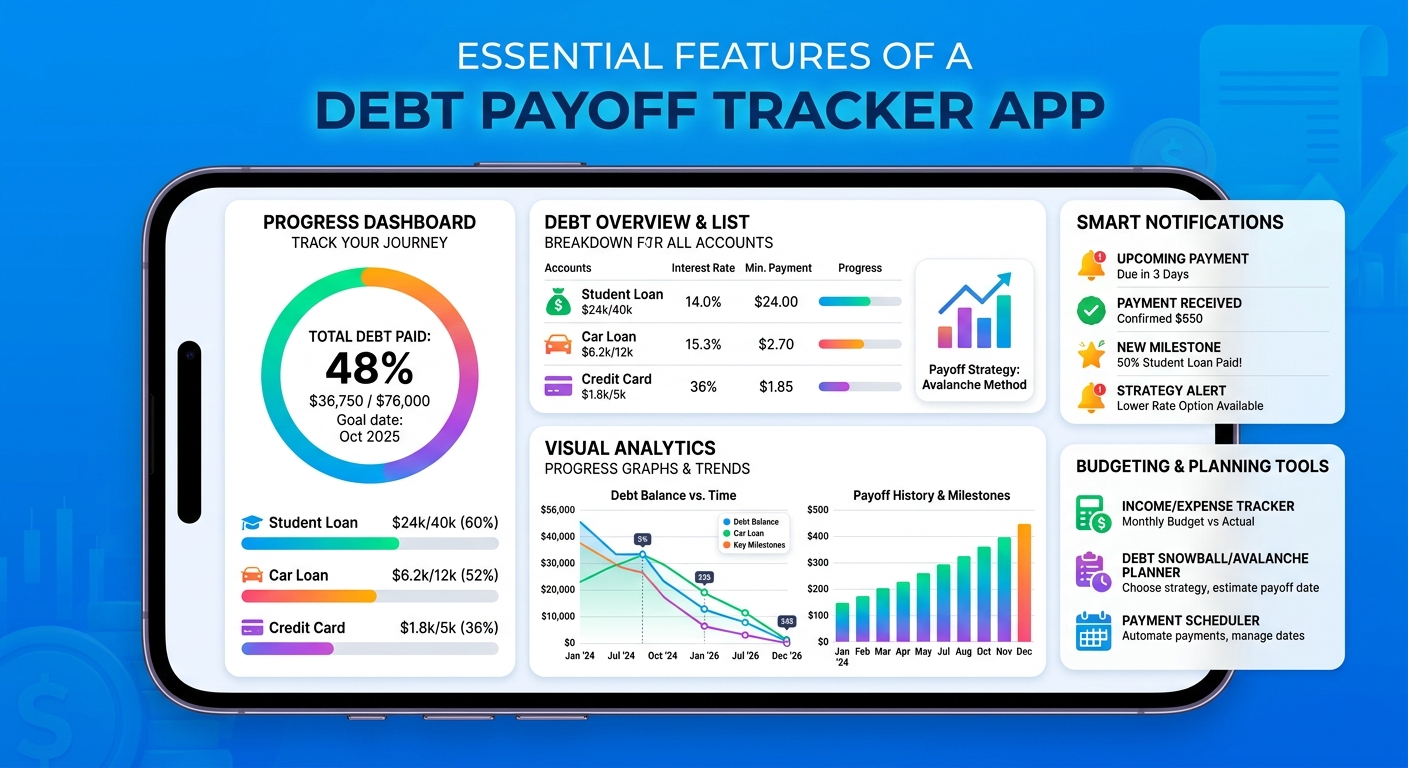 Not all debt tracking apps are created equal. The difference between apps that actually help you crush debt versus those that just look pretty comes down to a few essential features that can make or break your payoff journey.
Debt avalanche and snowball methods are non-negotiable. Your app should offer both strategies so you can choose between paying off highest-interest debts first (avalanche) or smallest balances first (snowball). If you haven't settled on which approach fits your personality, the snowball vs. avalanche breakdown walks through exactly that decision. Avalanche is the mathematically cheaper of the two, and on a mixed portfolio of cards in the low-to-mid 20% APR range, choosing it over snowball routinely saves four figures in interest across a two-year payoff.
Visual progress tracking keeps you motivated when the going gets tough. Look for apps that show debt reduction graphs, percentage paid off, and projected payoff dates. Seeing a credit card balance drop from $8,500 to $6,200 in visual form hits different than just looking at numbers on a statement.
Customizable payment scenarios let you experiment with "what if" situations. Can you see how adding an extra $50 monthly payment affects your timeline? What about using your tax refund as a lump sum? This is where most people discover the leverage in their plan: on a typical five-figure card balance, adding $100 a month to the minimum can pull months off the payoff date.
Automatic syncing with bank accounts eliminates manual data entry and keeps your information current. However, if you're uncomfortable linking accounts, ensure the app allows easy manual updates without making you re-enter everything from scratch.
Multiple debt type support is crucial since most millennials juggle various debts. Your app should handle credit cards, student loans, personal loans, and even mortgages with different interest rates and payment structures.
Budget integration features help you find extra money for debt payments. The best apps don't just track what you owe, they help you identify where you can cut spending to accelerate payoffs. Look for expense categorization and spending analysis tools.
Payment reminders and alerts prevent missed payments that can derail your progress. Late fees and interest rate increases can add hundreds to your debt load, so automated reminders are essential.
Export capabilities matter more than you think. Being able to export your data to spreadsheets or share progress reports with accountability partners (or financial advisors) keeps you on track.
Finally, realistic timeline projections separate good apps from great ones. Your app should account for interest rate changes, minimum payment adjustments, and provide honest timelines, not overly optimistic projections that set you up for disappointment.
Choose an app with at least 5-6 of these features, and you'll have the digital foundation needed to tackle your debt systematically rather than hoping for the best.
Top Debt Payoff Tracking Apps Reviewed (Including Free & Paid Options)
Here are the apps that actually help you crush your debt, based on how each one handles payoff strategy, tracking friction, and cost.
YNAB (You Need A Budget) - $14/month This is the gold standard for serious debt fighters. YNAB forces you to assign every dollar a job before you spend it, which is exactly what you need when tackling debt. The app's debt payoff features let you prioritize payments and track progress in real-time. Yes, it costs money, but YNAB reports that users typically save $600 in their first two months.
Debt Payoff Planner - Free (Premium $2.99) Perfect for visual learners who want to see their debt snowball or avalanche strategy in action. The free version handles up to 12 debts and shows you exactly when you'll be debt-free. Upgrade to premium for unlimited debts and detailed payment calendars. This is a strong pick for the middle stretch of a payoff, when the finish line is still far off and the timeline view is what keeps you going.
Mint - Completely Free While primarily a budgeting app, Mint's debt tracking features are surprisingly robust. It automatically categorizes your debt payments and shows trends over time. The credit score monitoring is a nice bonus. Downside? Limited customization for specific payoff strategies.
Tally - Free (but requires good credit) This app is different. It actually pays your credit card bills for you using a lower-interest line of credit. Tally advertises average interest savings of $5,300 for its users. The catch? You need a credit score of 660+ to qualify.
Goodbudget - Free (Premium $7/month) Based on the envelope budgeting method, this app helps you allocate specific amounts toward debt payments. The free version covers 10 envelopes and one account sync. Perfect if you prefer the psychological benefits of envelope budgeting but want digital convenience.
Unbury.Me - Completely Free (Web-based) Don't overlook this simple web tool. Just input your debts, and it calculates your optimal payoff strategy with precise timelines and interest savings. No app download required. Bookmark it and check your progress monthly.
The Bottom Line Start with the free options to build your tracking habit, then upgrade if you need advanced features. The best app is the one you'll actually use consistently. It is also normal to switch apps once or twice over a long payoff as your needs change, and switching is not a sign the plan is failing.
Remember: tracking alone won't pay off your debt, but it will keep you motivated and on course when the journey gets tough. If you're deep in the grind and feeling like progress has stalled, our guide on debt fatigue and how to keep going covers how to push through the middle months.
How to Choose the Right App for Your Debt Strategy
Choosing the right debt payoff app isn't about finding the "best" one. It's about finding your perfect match. The wrong app will sit unused on your phone while the right one becomes your daily financial companion.
Start with your debt complexity. If you're juggling 2-3 credit cards with similar balances, a simple app like Debt Payoff Planner works perfectly. But if you're managing student loans, credit cards, a car payment, and personal loans all at once, you need something robust like YNAB or EveryDollar that handles multiple debt types and payment schedules.
Match the app to your motivation style. Visual learners should prioritize apps with progress bars and charts, because watching a debt thermometer shrink each month is what carries people through the weeks where nothing else feels like progress. If you're numbers-driven, focus on apps that show exact payoff dates and interest savings. Some people need gamification features, while others prefer straightforward tracking.
Consider your budgeting habits. Apps like Mint excel if you want everything automated, tracking spending and suggesting debt payments based on your patterns. But if you prefer hands-on control (which we recommend), choose apps that let you manually input payments and adjust strategies as your income changes.
Test the debt payoff strategies offered. Most apps support debt snowball (smallest balance first) and debt avalanche (highest interest first), but some offer hybrid approaches. Flexibility matters more than it looks on day one, because motivation is not constant across a multi-year payoff and being able to switch methods mid-stream keeps people in the game.
Don't overlook integration capabilities. The best apps sync with your bank accounts for automatic updates, but also consider whether they integrate with your existing financial ecosystem. If you're already using Quicken for taxes, pick an app that exports data seamlessly.
Factor in your commitment level. Free apps work great if you'll actually use them consistently. But if you need accountability features, customer support, or advanced analytics, investing $5-15 monthly in a premium app often pays for itself. Paid tiers usually justify themselves through detailed progress reports, which are the feature most tied to staying accountable over time.
Try before you commit. Download 2-3 apps that match your criteria and use them for one week each. Input your actual debt numbers and test the interface during different scenarios: making payments, adjusting budgets, checking progress. The right app will feel intuitive, not like homework.
The app that helps you stick to your plan is infinitely better than the "perfect" app you never open.
Maximizing Your App: Tips for Faster Debt Freedom
Having the right app is just the beginning. The real magic happens when you use it strategically to accelerate your debt payoff timeline.
Set up automated tracking by linking your bank accounts and credit cards directly to your chosen app. Manual entry is the single biggest reason tracking habits die, because it turns a two-second check into a weekly chore. Automating the sync removes that friction entirely and frees up the hours you would have spent reconciling balances by hand.
Use the debt avalanche method for maximum mathematical efficiency. Your app should automatically calculate which debt to tackle first based on interest rates. For example, if you have a credit card at 24.9% APR and a student loan at 6.8%, every extra dollar goes to that credit card first. This strategy can save you thousands in interest compared to the snowball method.
Leverage gamification features to stay motivated during tough months. Most apps offer progress bars, milestone celebrations, and payoff projections. Set mini-goals like "pay off $1,000 this quarter" rather than focusing solely on your total debt mountain. Small wins create momentum that compounds over time.
Track your debt-to-income ratio monthly using your app's analytics. Aim to keep this below 36% for all debts combined, with no more than 28% going to housing costs. When you see this number dropping consistently, it reinforces that your strategy is working.
Use the "found money" feature religiously. Whether it's a $20 cash-back reward or a $200 tax refund, immediately allocate these windfalls through your app. These seemingly small amounts compound: routed consistently to principal over a multi-year payoff, windfalls alone can pull several months off the finish date.
Set up aggressive payment reminders for dates that align with your paychecks. If you're paid bi-weekly, schedule extra payments for the two months each year when you receive three paychecks. This "bonus payment" strategy can eliminate an entire year from a typical 5-year debt payoff plan.
Review your app's projections weekly, not monthly. Markets change, interest rates fluctuate, and your income might increase. Apps that sync with current rates will show you exactly how an extra $50 monthly payment impacts your freedom date. Often, you'll discover that small increases create disproportionately large time savings.
The key is consistency over perfection. Use your app daily for the first 30 days to build the habit, then maintain weekly check-ins to stay on track toward your debt-free future.
Get Strategies That Actually Work
Research-backed debt payoff strategies, delivered weekly. Free, no spam.
About the Author
DebtExit Editorial
Research-backed debt payoff strategies
DebtExit publishes research-backed debt payoff strategies and free planning tools. Articles are sourced from the Consumer Financial Protection Bureau, the Federal Reserve, Experian, and peer-reviewed research, then reviewed against our published editorial standards. DebtExit provides educational content, not personalized financial advice.