How to Rebuild Credit After Paying Off Debt
Written by DebtExit Editorial
Reviewed against our editorial standards
Congratulations! Why Credit Score Recovery Matters Now
First off, congratulations on paying off your debt! You've accomplished something that millions of Americans struggle with daily. But here's what many people don't realize: your credit score journey is just beginning, not ending.
Right now, your credit score might still look rough despite your debt-free status. That surprises almost everyone. Scores are backward-looking, and the reporting cycle runs on a delay, so the payoff you completed this month may not be fully reflected for another billing cycle or two. Expect the real improvement to arrive over the following several months of consistent behavior, not the week after your final payment.
Your credit score is your financial reputation, and it affects nearly every major purchase you'll make. A large score gap can mean tens of thousands of dollars more in interest over the life of a 30-year mortgage. That's real money staying in your pocket versus going to lenders.
Here's why focusing on credit recovery matters more now than ever: you have a clean slate. Without monthly debt payments draining your resources, you can finally implement credit-building strategies that were impossible before. You have cash flow, breathing room, and the financial discipline that got you debt-free in the first place.
The numbers tell the story. A credit score of 740+ unlocks the best rates across all lending products. Below 640, you're looking at subprime rates or outright rejections. The difference between a 620 and a 750 credit score on a $25,000 auto loan can run roughly $3,500 in extra interest over five years.
But here's the encouraging part: post-debt payoff is actually the fastest time to rebuild credit. You're not fighting new debt while trying to improve your score. Every positive action you take compounds without negative interference.
Your timing is good for another reason. Credit scoring models weight recent behavior heavily. Those late payments from two years ago are losing influence every month. Meanwhile, the positive payment history you're about to build carries increasing weight.
Think of this phase as your credit score acceleration period. You've proven you can eliminate debt, and now you'll prove you can manage credit responsibly. The strategies below are the ones that move scores meaningfully over a 6 to 12 month window, but only if you start implementing them now.
The financial doors that open with a strong credit score (better mortgage rates, premium rewards cards, lower insurance premiums in many states) make this effort worthwhile. You've already done the hard part by becoming debt-free. Now let's turn that achievement into long-term financial advantage.
Immediate Action: Cleaning Up Your Credit Report Post-Payoff
Now that you've crushed your debt (seriously, take a moment to celebrate that win), it's time to clean house on your credit report. Think of this as spring cleaning for your financial life, and it's just as crucial for your fresh start.
Start with a comprehensive credit report review from all three major bureaus: Experian, Equifax, and TransUnion. You can grab these free at annualcreditreport.com. Don't just glance. Scrutinize every single line item like you're hunting for treasure.
Look for paid-off accounts that still show balances. This is one of the most common post-payoff reporting errors. Creditors update the bureaus on their own cycle, and an account you zeroed out in March can still be reporting a February balance in May. It matters more than it sounds, because credit utilization is roughly 30% of a FICO score, so a phantom balance can hold your score down for months. A single dispute usually clears it.
Dispute any inaccuracies immediately. Common errors include wrong payment dates, accounts that aren't yours, and duplicate entries. File disputes online through each bureau's website. It's faster than mail, and the bureaus generally have 30 days to investigate.
Here's a pro move: request "paid in full" letters from every creditor you just finished paying off. Keep these as your insurance policy. If any paid account resurfaces as unpaid later, you'll have documentation to shut it down fast.
Don't close old credit cards, even if you're tempted to cut them up in celebration. Keep those accounts open to maintain your credit history length and available credit. Just tuck the cards away in a drawer.
Check for accounts in collections that should be marked as paid. Collection agencies are notoriously slow to update credit reports. If you paid a collection account as part of your debt payoff, make sure it shows as "paid" or "settled" rather than still active.
Set up credit monitoring to catch future issues before they snowball. Many banks offer free monitoring, or use Credit Karma for basic tracking. Our debt and credit tracking app guide has other tools worth bookmarking. You want alerts the moment something changes on your report.
Finally, document everything. Screenshot your current credit reports and save confirmation numbers from any disputes you file. This creates a paper trail that'll save you headaches if issues pop up later.
This cleanup phase typically takes 30 to 60 days to complete, but it's the foundation everything else builds on. Skip this step, and you'll be trying to rebuild on shaky ground. Do it right, and you'll see improvements start flowing in within weeks.
Strategic Moves: Leveraging Key Factors to Boost Your Score
Now that you've conquered your debt, it's time to strategically optimize the five factors that determine your credit score. Think of this as fine-tuning an engine: small adjustments in the right places create dramatic improvements.
Payment history remains king, accounting for 35% of your score. Since you've already proven you can pay off debt, maintaining perfect payment history should be your non-negotiable foundation. Set up autopay for at least minimum payments on all accounts, even if you plan to pay more manually.
Credit utilization is your quickest win, representing 30% of your score. Keep your total utilization below 10% across all cards, but here's the finer point: aim for 1% to 3% utilization on one card while keeping others at zero. This shows active credit use without appearing risky to lenders.
Statement timing is the piece most people miss. Most issuers report your statement closing balance to the bureaus, not the balance after you pay. So a $500 balance on a $1,000 limit card reports as 50% utilization even if you pay it in full a week later. Pay the balance down before the statement closes, not just before the due date, and the lower number is what the bureaus see.
Length of credit history (15% of your score) requires patience, but you can protect it now. Keep your oldest accounts open and active with small, recurring purchases like a streaming subscription. Never close your first credit card unless it carries an annual fee you can't justify.
For credit mix (10% of your score), you don't need to go crazy opening accounts. If you only have credit cards, an installment account such as a small personal loan or an existing auto loan adds diversity. The key is natural diversity, not forced complexity, and never take on debt purely for scoring purposes.
New credit inquiries (10% of your score) require restraint during rebuilding. Space out applications by at least 3 to 6 months, and when you do apply, shop for the same type of credit within a 14 to 45 day window so the inquiries are treated as one.
Here's a lever many people miss: become an authorized user on a family member's account with excellent payment history and low utilization. Their positive history can appear on your report within a billing cycle or two. Confirm with the issuer that it reports authorized users, because not all do.
Finally, consider the two-card strategy: use one card for fixed monthly expenses with autopay, and another for variable spending that you pay off weekly. This creates consistent payment history while maintaining ultra-low utilization.
Remember, consistency beats perfection. These strategic moves compound over time, turning your debt payoff victory into a credit score that opens doors to better rates and opportunities.
Hands-On Tactics: Specific Tools for Rapid Credit Rebuilding
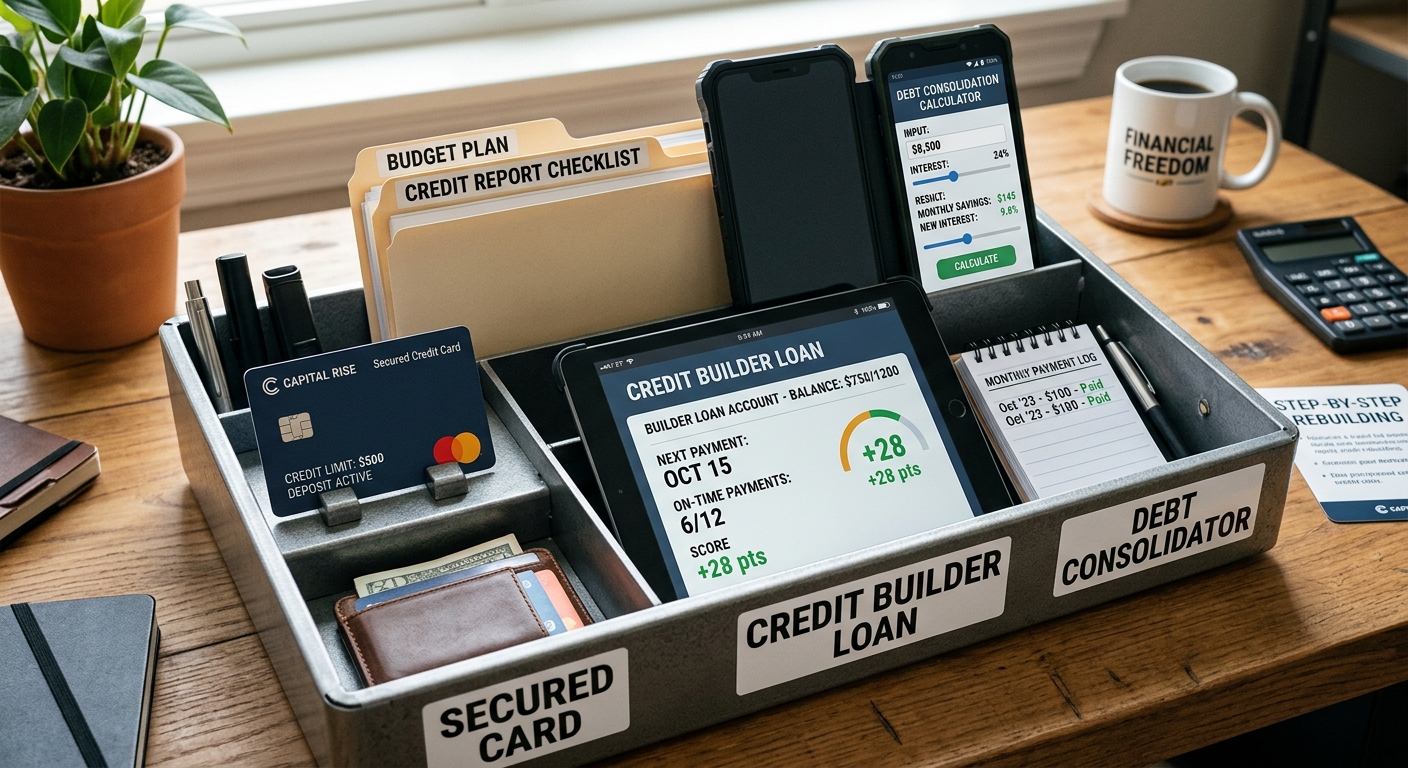 Now that you've cleaned up your credit report, it's time to get aggressive about rebuilding. These aren't theoretical strategies. They're the specific tools that map directly onto the scoring factors above.
Start with a secured credit card immediately. Even if your score is still recovering, you can generally get approved for a secured card with a $200 to $500 deposit. Use it for one small recurring bill like a streaming subscription, then set up autopay for the full balance. This creates perfect payment history without any risk of overspending.
Request credit limit increases every 90 days on existing cards. Don't wait until you "feel ready." Most issuers allow online requests, and many process them as soft pulls that won't hurt your score. Even a $500 increase on a card you rarely use improves your credit utilization ratio.
Become an authorized user strategically. Ask a family member or trusted friend with excellent credit (750+ score, low utilization) to add you to their oldest, highest-limit card. Their positive payment history can appear on your report once the issuer reports the account. Ask first whether the issuer reports authorized users to all three bureaus, since the tactic does nothing if it doesn't.
Use the 10% utilization sweet spot religiously. Keep total utilization under 10% across all cards, but don't go to zero on everything. A small reported balance shows active credit management. If your total credit limit is $3,000, never carry more than $300 across all cards combined.
Pay down balances before statement dates. This is the tactic most people miss. Your utilization is reported based on your statement balance, not what you eventually pay. If you charge $800 but pay it down to $100 before your statement cuts, only the $100 gets reported.
Consider a credit-builder loan if you need payment history diversity. Self and Credit Strong offer these specifically for rebuilding. You make payments into a savings account, then get the money back when the loan term ends. It's like forced savings that builds credit simultaneously.
Monitor your progress. Use Credit Karma or your credit card's free monitoring to check your score monthly. Screenshot the trend. Seeing the line move up is what keeps the habits in place through the slow months.
Time your applications strategically. Once your score recovers into the mid-600s, you can start applying for better cards, but space applications at least 90 days apart. Each hard inquiry costs a handful of points temporarily, while the increased credit limits help your utilization long-term.
The key is consistency over perfection. These tactics work, but only if you stick with them for 6 to 12 months. Your score didn't tank overnight, and it won't recover overnight. With these specific moves, though, the direction of travel is steadily upward.
Sustaining Success: Smart Habits for Long-Term High Scores
You've done the hard work of rebuilding your credit score, but maintaining those gains requires consistent habits, not sporadic efforts. The difference between temporary improvement and lasting financial health lies in what you do every single day.
Set up automatic payments for at least the minimum on all your accounts. A single 30-day late payment is one of the most damaging single events a credit file can absorb, and it stays on your report for seven years. Payment history makes up 35% of your credit score, so this one habit protects your biggest scoring factor.
Keep your credit utilization below 10% across all cards, not just overall. If you have a $5,000 limit, never carry more than $500. Even better, pay down balances before your statement closes to report low balances while keeping accounts active.
Review your credit reports quarterly, not just annually. Set calendar reminders for January, April, July, and October. Look for new accounts you didn't open, incorrect balances, or outdated negative information that should have fallen off.
Resist the urge to close old credit cards unless they have annual fees you can't justify. Your credit age accounts for 15% of your score. That card you got in college might seem useless, but it's quietly supporting your average account age every month.
Use a simple limit on new credit applications: no more than 1 application per month, 3 per year, or 5 over two years. Each hard inquiry can drop your score a few points temporarily, and multiple inquiries in a short period compound the effect.
Diversify your credit mix strategically. Having a mortgage, car loan, and credit cards shows you can manage different types of credit. But don't take on debt just for scoring purposes. Only add credit products that serve your actual financial goals.
Monitor your score monthly with free tools like Credit Karma or your bank's app. Watch for sudden drops that might indicate identity theft or reporting errors. Quick action can prevent small issues from becoming major problems.
Build an emergency fund of 3 to 6 months' expenses to avoid using credit cards for unexpected costs. If you're still weighing whether to build savings or pay off remaining debt first, that guide runs the math. The best credit strategy is not needing credit at all for emergencies.
Remember, excellent credit scores (750+) aren't built overnight. They're maintained through boring, consistent habits. The same discipline that got you out of debt will keep your credit score strong for decades to come. If you're still in the payoff phase and wondering how much longer it will take, see our debt payoff timeline guide for realistic benchmarks.
Get Strategies That Actually Work
Research-backed debt payoff strategies, delivered weekly. Free, no spam.
About the Author
DebtExit Editorial
Research-backed debt payoff strategies
DebtExit publishes research-backed debt payoff strategies and free planning tools. Articles are sourced from the Consumer Financial Protection Bureau, the Federal Reserve, Experian, and peer-reviewed research, then reviewed against our published editorial standards. DebtExit provides educational content, not personalized financial advice.